
some works of art stay with me long after i've walked away. here are five very different pieces that have made a lasting impression, for very different reasons.
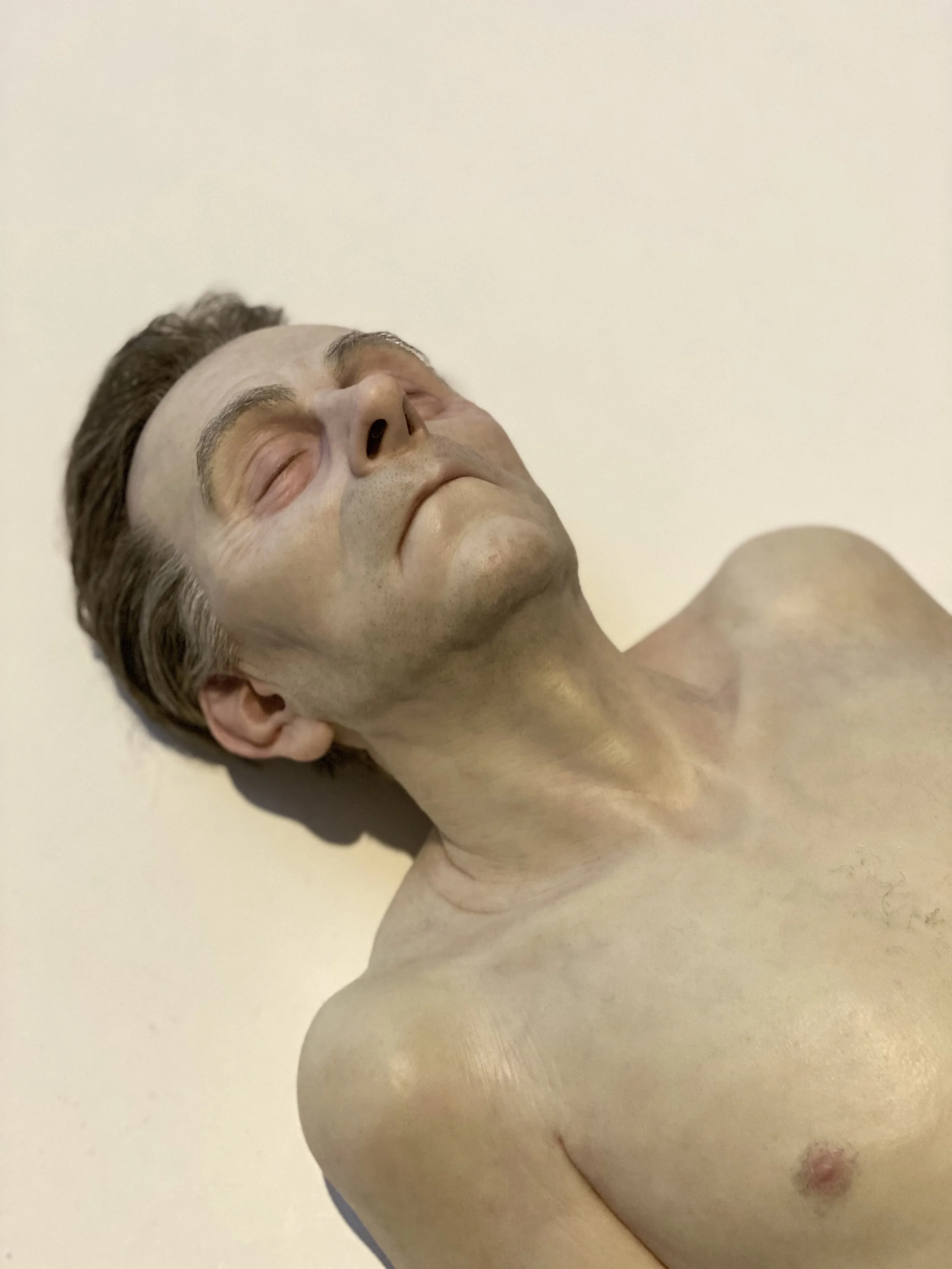
ron mueck, dead dad, 1996-7
there are plenty of reasons why we buy, collect or simply enjoy looking at art. sometimes it's the artist, sometimes the subject, sometimes the colours or the technique. occasionally, though, you come across something that stops you in your tracks. something that makes you think, challenges you, unsettles you or just makes you feel different.
over the years, i've been fortunate enough to see some extraordinary works of art and a few have stayed with me.
these five are all very different, but each has moved me in its own way.
01. myra – marcus harvey
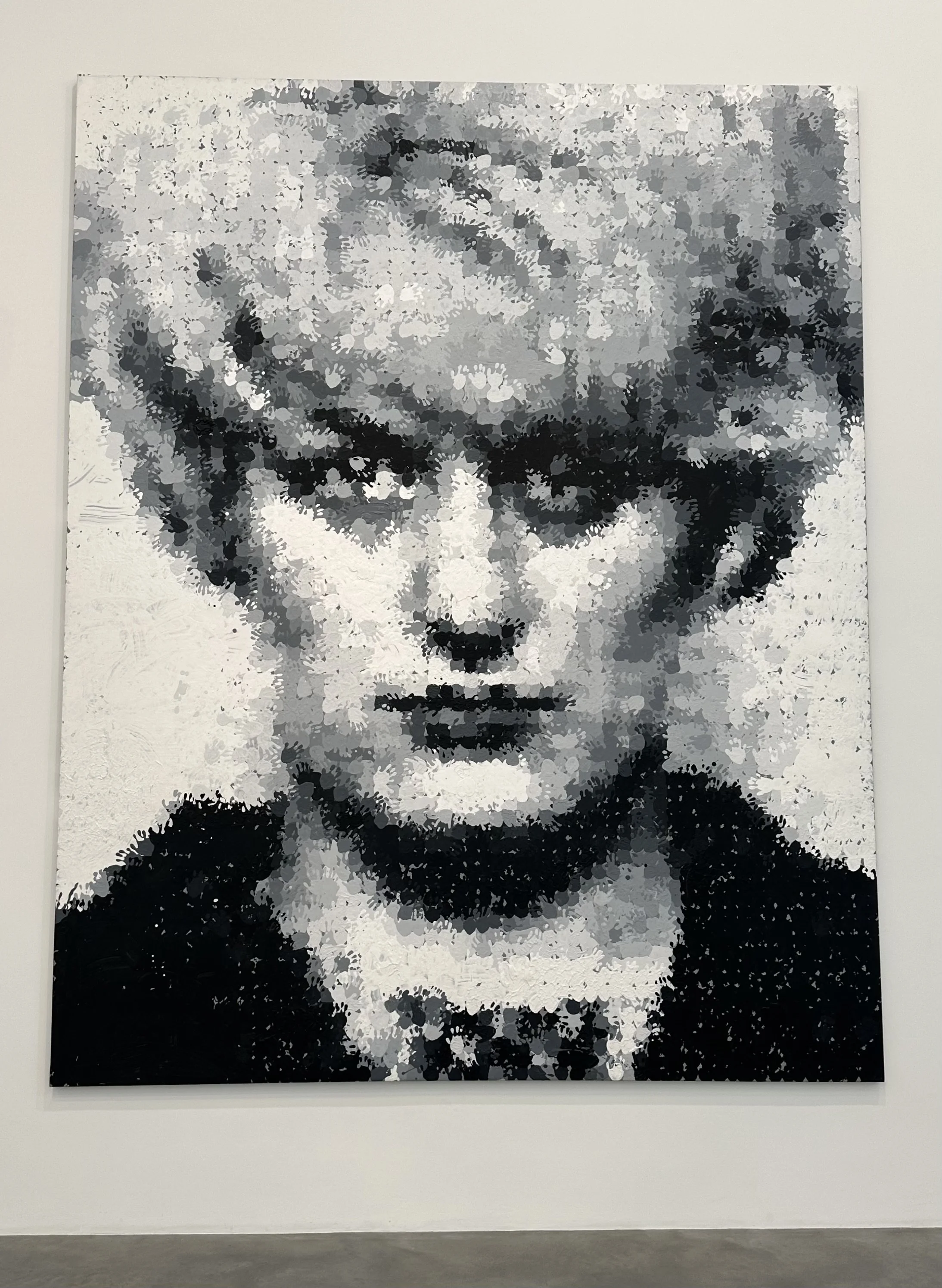
marcus harvey, myra, 1995
i first saw marcus harvey's infamous portrait of myra hindley at the saatchi gallery during the years when it’s home was at county hall in london (2003-2005). the painting was on display alongside hirst and other ybas including the chapman brothers, tracey emin, jenny saville and sarah lucas. it was an incredible show.
at first glance, harvey’s painting is a fairly straightforward portrait of one of the most notorious figures in british criminal history. on closer inspection however, you realise that the image has been constructed using hundreds of children's handprints. the small handprints, made using paint, combine to create the face of a woman whose crimes involved the abuse and murder of children.
it's an incredibly uncomfortable piece of work, and deliberately so. the contrast between the innocence of the handprints and the evil of the person they collectively depict hits hard.
the painting caused enormous controversy when it was exhibited at the royal academy's sensation exhibition in 1997 (also an awesome show), but beyond the headlines and the outrage, what struck me was the sheer audacity of the idea and how effectively the technique reinforces the horror of those should-never-be-forgotten events.
the image has stayed with me ever since.
02. the sphere – fritz koenig
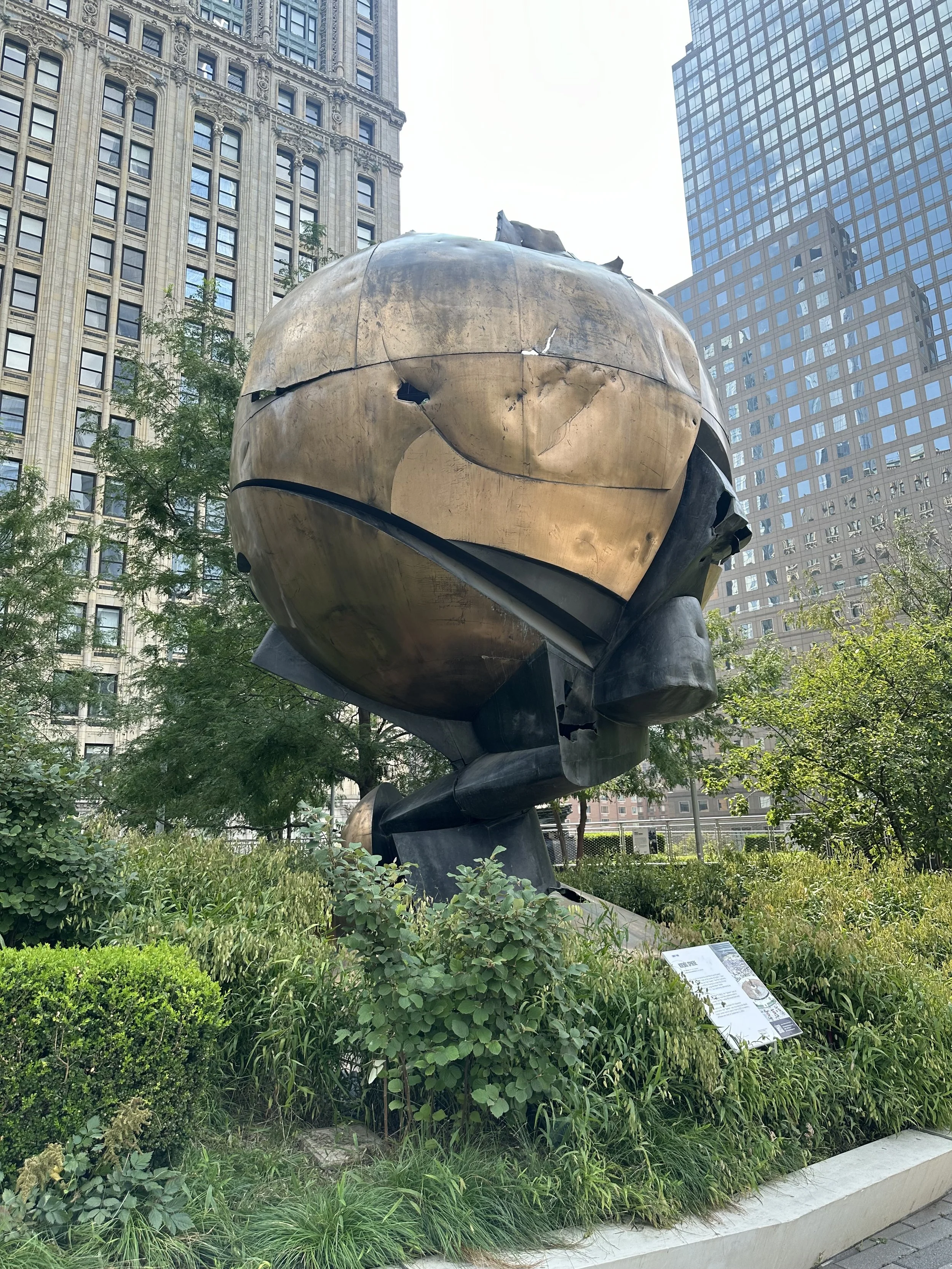
fritz koenig, the sphere, 1968-71
this is an artwork that has acquired an entirely new meaning because of events that happened around it.
fritz koenig's monumental bronze sculpture, titled the sphere, originally stood in the plaza between the twin towers of the world trade centre in new york. it was designed as a celebration of world peace through world trade, a symbol of harmony and international cooperation.
on september 11th 2001, it survived the collapse of the towers.
it was badly damaged, battered and bruised, down but not out. in spite of everything, it remained largely intact.
in the aftermath of the attacks, it was recovered from the rubble and eventually became a temporary memorial at battery park, before being relocated to liberty park, overlooking the world trade centre site.
i've seen it in person, and it's proximity to the 9/11 memorial (reflecting absence, 2011, another artwork that hits-you-like-a-train), is an incredibly emotional experience.
looking at this battered bronze sculpture and knowing what it survived, gives it a presence far beyond its original artistic intention.
the sphere wasn't created to be a memorial, but history has made it one.
03. welcome mat – banksy
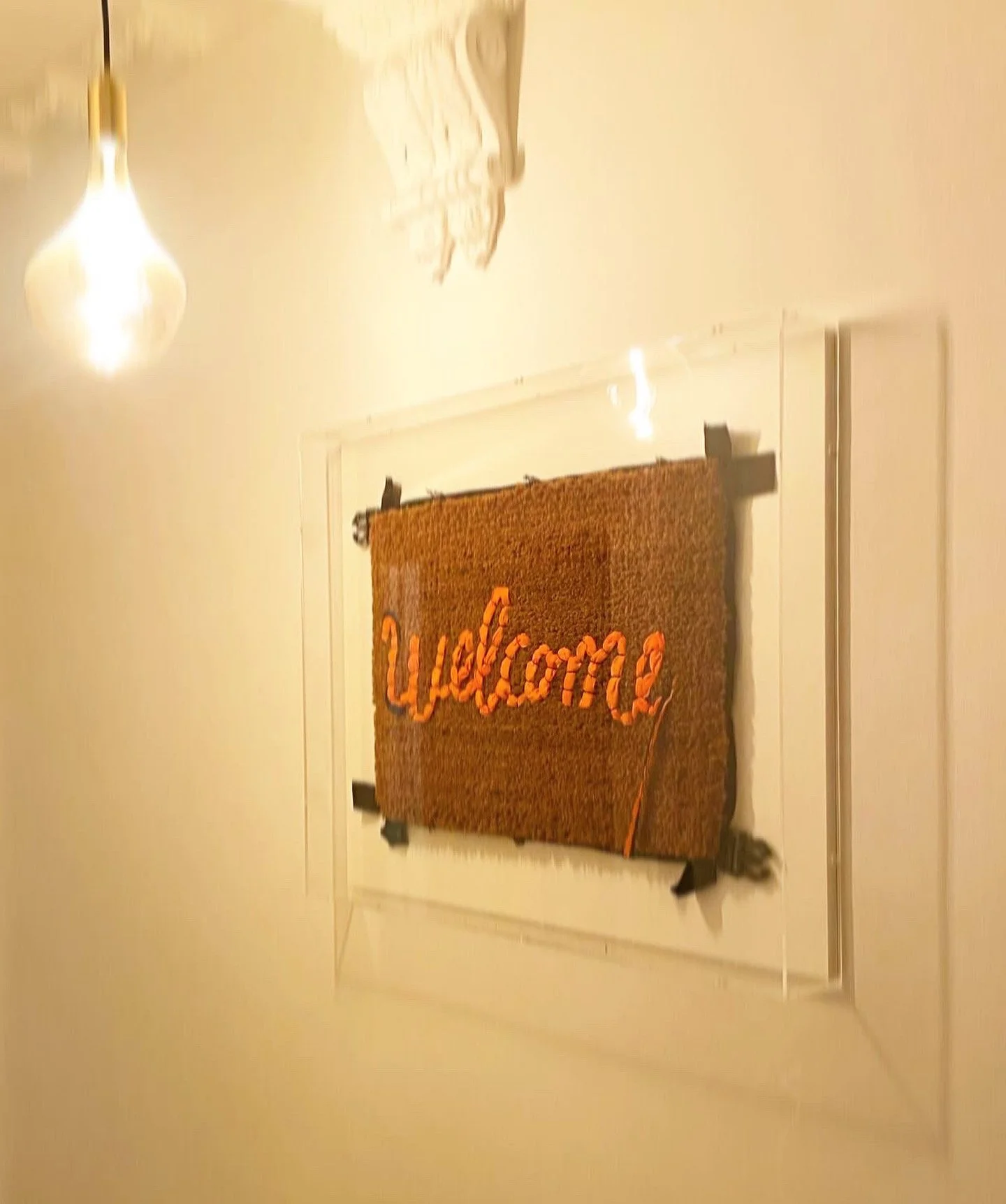
banksy, welcome mat, 2019
i should (and often need to) explain why i've got a doormat hanging on my wall.
it's a perfectly reasonable question to ask. it's not the sort of thing you'd normally expect to find framed and displayed prominently in the hallway of a house. but of course, this isn't your average B&Q doormat.
banksy's welcome mat is made using strips of life jackets abandoned on beaches in the mediterranean by refugees attempting to reach europe. the ‘welcome’ lettering is hand-stitched from the salvaged material, transforming something associated with one of the most basic gestures of hospitality into a reminder of the desperate journeys made by people fleeing their homes.
i think it's brilliant.
these are life jackets worn by people who have risked everything to reach somewhere safer and the contrast between the welcome mat in our homes and the welcome that many refugees actually receive is both clever and deeply uncomfortable.
it's also a great example of what banksy does so well. he takes something familiar, changes it up and makes you think about something that, 9 times out of 10, you’d rather not think about.
it's without doubt the single piece in my collection that attracts the most attention. people look at it, ask me why the f*** i've got a framed doormat on the wall, and then, once i explain what they're looking at, their POV changes immediately.
and that's the point, really.
i admire banksy for creating something that carries such a powerful message. it gets noticed, it starts conversations and it highlights the plight of people who are often reduced to statistics or headlines.
it’s a long way from a B&Q doormat.
04. the boros collection – berlin
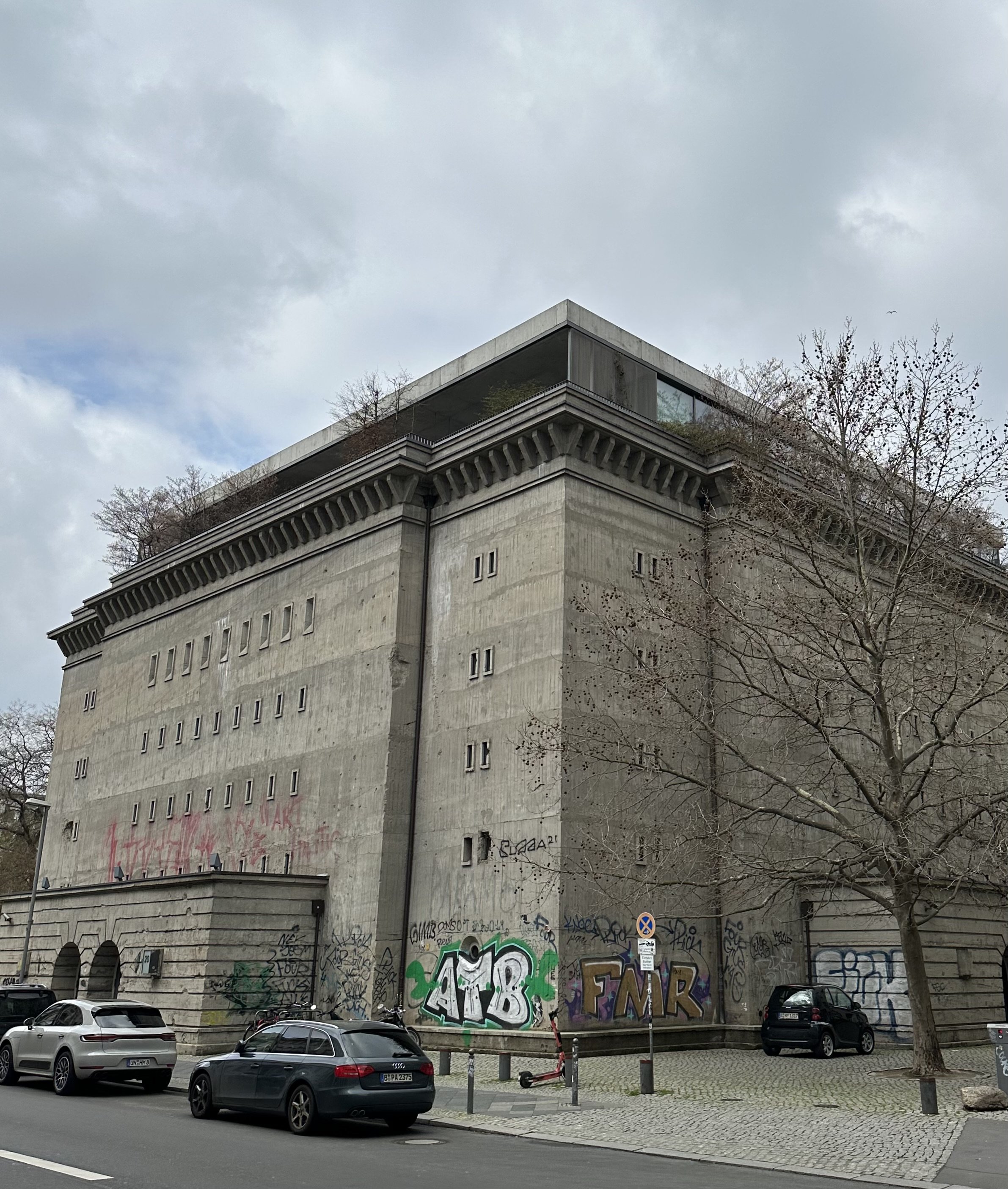
the boros bunker, berlin
i love berlin, and one of the things i'd recommend to anyone visiting the city with even a passing interest in contemporary art or architecture is a visit to the boros collection.
it's not a conventional gallery, which for me at least, is what makes it so special and ultimately, memorable.
the boros collection is housed in an enormous, oppressive and frankly, quite ugly former air-raid bunker smack bang in the centre of berlin. built during the second world war, the building has had an extraordinary history serving various purposes (once a textile warehouse then an imported tropical fruit storage facility and even a fetish and fantasy nightclub) before being bought by art collectors christian and karen boros who painstakingly transformed it into a private museum. they even built their penthouse home on top of it!
i find the whole concept fascinating. a building with such a bleak and chequered history has been transformed into a place to house and share a collection of contemporary art. and it's the boros’s collection, not a public institution's. you're effectively being invited into somebody's home to view their extraordinary collection of art.
so what about the art?
you can't simply wander around the building as you please (sadly), visits are by guided tour only. fortunately, what might sound a little restrictive, actually considerably enhances the experience. the guides provide fascinating insight into not just the artists and works in the collection, but also the history of the building and the boros family’s dna that gives you a real sense of the thinking behind it all, rather than simply walking from one room to another looking at things on the walls (and on the floor and hanging from ceilings).
set against thick, bare concrete walls (aside from the graffiti, a throwback to the building's former life as a hardcore techno club), the contrast works perfectly.
three artists in particular whose work stayed with me:
louis fratino - queer life
anna uddenberg - s&m mannequins
bunny rogers - romanesque online video game characters
you’ll have to look them up, cameras are not allowed in the bunker (another rule which serves only to enrich the experience - look, take it in, remember it).
i've visited plenty of galleries and exhibitions over the years, but the boros collection was an experience that has stayed with me.
here, the setting, as much as the art itself, created the memories.
05. dead dad – ron mueck
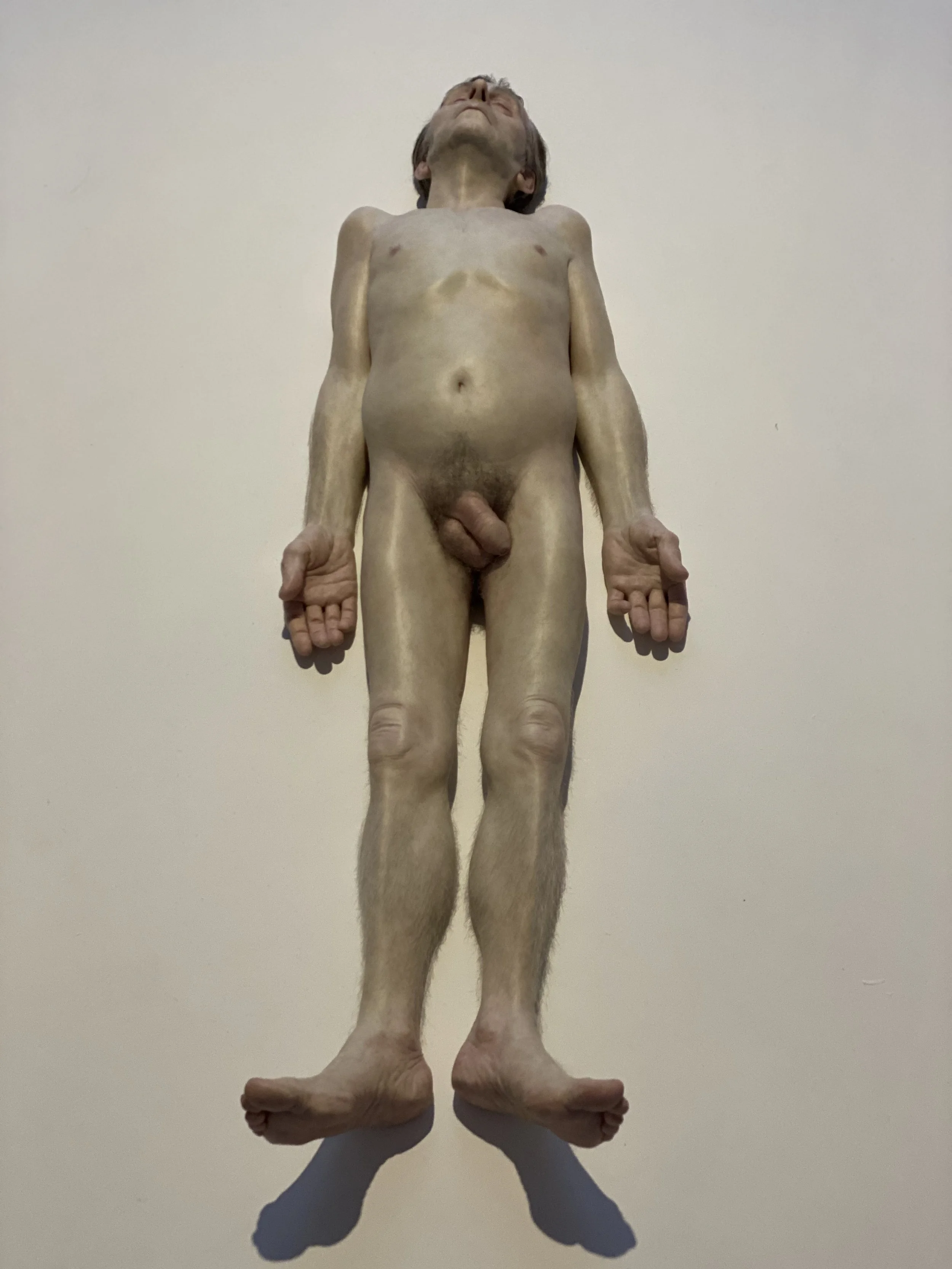
ron mueck, dead dad, 1996-7
this is probably the most personal of the five.
i saw ron mueck's dead dad at an exhibition in london (thaddeus ropac, 2021) a few years ago and it was captivating.
mueck is extraordinary at creating sculptures that look almost impossibly lifelike. the detail is astonishing. the texture of the hair, the eyelids, the fingernails… you have to remind yourself that you're looking at a sculpture.
but it’s the subject matter that really got under my skin.
dead dad is a half-life-size representation of mueck's deceased father, lying naked on his back. it's both intimate and unsettling. there's no attempt to make death look beautiful or dignified. it's simply a human body, lifeless and vulnerable.
i found myself thinking about mueck's relationship with his father, and what it must have meant to create something like this.
i also found myself thinking about my own dad, and my relationship with him. about the inevitability of death, about his death and how i will have to come to terms with it along with the unanswered questions that will die with him.
and then, inevitably, i thought about my own children and that one day they will have to deal with losing me (and if, on reflection, they think I was a good dad).
so although it's a very personal sculpture for mueck, it somehow manages to make you think about your own family and your own place in the cycle of life.
it's not an easy work to look at, but it's difficult to look away.
thanks for the memories
ron mueck, dead dad, 1996-7
in their own distinct ways, each of these five pieces forces a confrontation with uncomfortable realities.
marcus harvey’s myra uses innocence to construct pure evil, while fritz koenig’s the sphere stands as a battered symbol of survival against destruction.
banksy’s welcome mat transforms domestic hospitality into a sharp critique of global displacement, mirroring the way the boros collection subverts a bleak war bunker into a sanctuary for defiant contemporary art.
finally, ron mueck’s dead dad strips away all artistic pretense to lay bare the stark reality of human mortality.
they are five entirely different encounters, but each one succeeded in doing what great art does best: it stopped me in my tracks, refused to let me look away and has stayed with me ever since.