
on buying what you love, buying a name, and learning a few lessons along the way.
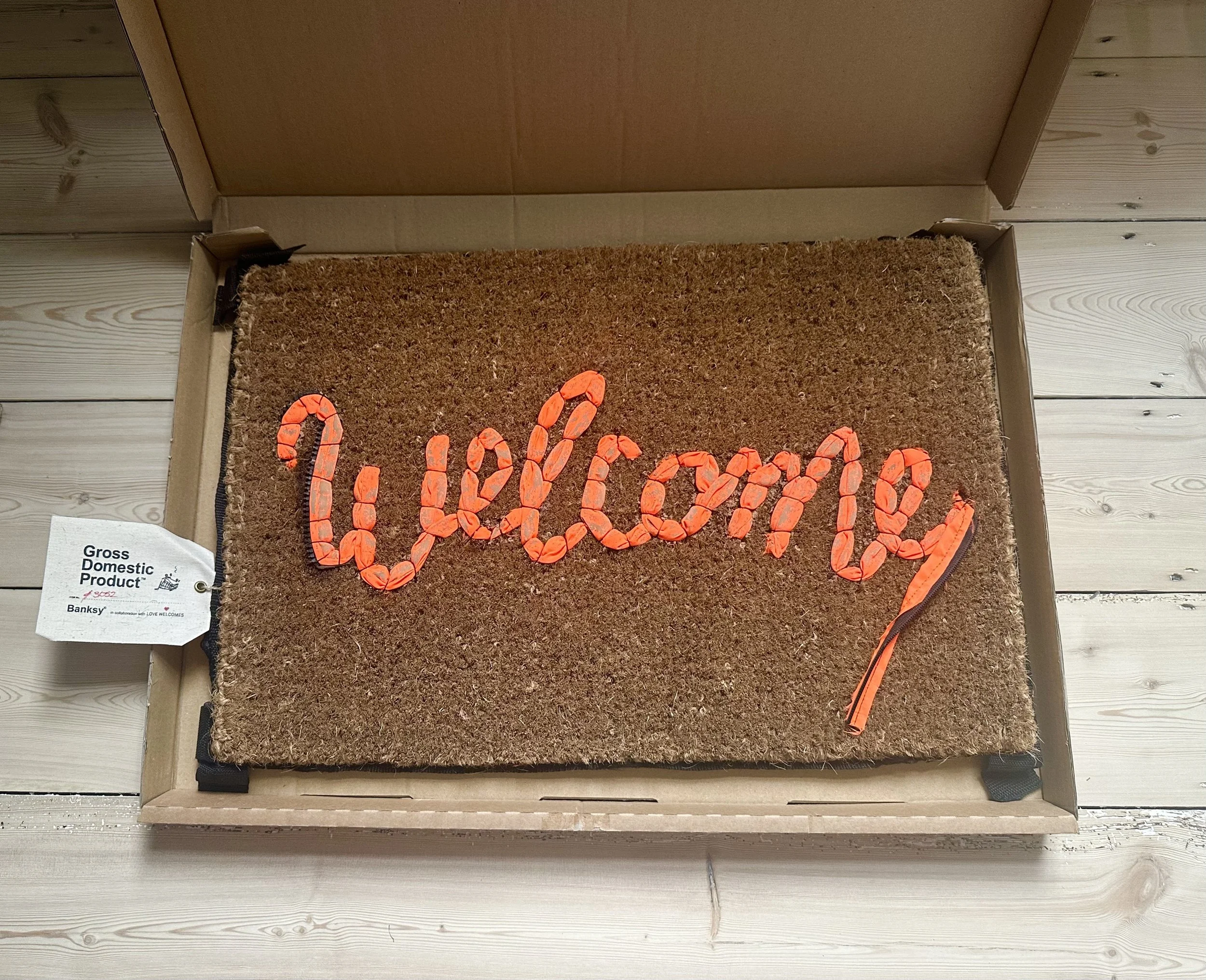
banksy welcome mat, 2019
the collection i have today has been shaped by two things: buying art i love and buying a name.
my collecting journey began with banksy. buying his work gave me something more valuable than a few successful purchases. it gave me the confidence to keep collecting.
at the time, i was living in east london, where banksy's work was everywhere. his spray paint stencil images on every wall, shutter and newsstand. i used to pass some of them on the way to work and when a new one appeared i’d go and take a look. so i was aware of him, but i had no idea that he produced prints that you could actually buy and hang on your wall.
that changed on a lads' weekend in brighton in 2003-ish where we stumbled across some of his prints entirely by chance in the window of the now defunct art republic gallery. the prices were low (£75 for an unsigned print and £150 for a signed one!) which nowadays seem extraordinary, but those were the prices back then.
one of my mates - let’s call him craig brooks from south wimbledon 😊 - spent a long time deliberating over whether to buy an unsigned girl with balloon print for his girlfriend. eventually, he passed on it, which turned out to be the most expensive decision he ever made.
at the time, spending £100 on a print was not something we did and who knew what would happen to banksy’s prices in the years that followed? of course, we've never let him forget it. we still send him auction results, our favourite being the bonhams sale on 15 december 2020, where an unsigned edition of girl with balloon sold for £300,250 (including the buyer's premium).
don’t worry craig, you only missed out on a return of around 400,000%!
the irony is that any one of us could have bought that print. but none of us did, because we didn't particularly like it. there, i’ve said it, i didn’t like the girl with balloon image that has become one of the most recognisable images in british contemporary art (a 2017 samsung poll of 2,000 people ranked it as their number one artwork). regardless of its eventual fame and value, at the time, it simply wasn't for me (nb. i still don’t like it and justin bieber has the image tattooed on his body, so enough said).
still, that weekend had piqued my interest in banksy’s prints and after a bit of research i discovered pictures on walls (aka pow), who helped bring art from the streets into people’s homes through editioned prints. one of their rostered artists was banksy and i bought a couple of signed editions: police kids and virgin mary.
over the next two or three years, their value increased significantly and i sold both for around £5,000 each and used the proceeds to buy a few more: a signed napalm artist's proof, a signed golf sale and an unsigned bomb hugger. i also bought a large print by julian opie, ruth smoking.
without really thinking about it, i had moved from buying a couple of prints by an artist whose work i liked to starting to build a collection. and, more importantly, i had started to understand how one purchase could lead to another.
as the value of my banksy prints increased, i became more comfortable buying work by other artists. i knew that, taken as a whole, my collection was still in profit, which gave me the confidence to explore beyond the familiar name that had started it all.
but it wasn't all plain sailing.
like most collectors, i've made mistakes along the way. one of the biggest was buying into the hype around other street artists. i wrongly assumed that the success of banksy (and pow) was a sign of things to come across the whole scene.
so i went all in and bought prints by antony micallef, paul insect, faile, dolk, nick walker, gee vaucher, 3d, d*face and others. my thinking was pretty straightforward, if a little naive: banksy had taken street art into the mainstream, so surely other established street artists would follow. buy the prints, sit tight and watch the prices go to the moon.
they didn't.
i eventually sold the non-banksy works and, in most cases, just about broke even. but it took a long time and all in all was a pretty stressful experience having lots of cardboard tubes under my bed holding prints that at best were worth what I paid for them. not something i'm keen to repeat.
the worst part? i had committed the cardinal sin. i had bought prints that i didn’t particularly like, so i couldn't even hang them and enjoy them. i was left with work i didn't really want, bought for reasons that turned out to be misguided.
foolish, really.
i'd made the mistake of assuming that because one artist had achieved extraordinary success, others working in a similar space would follow the same trajectory. but artists aren't interchangeable, and being part of a movement or sharing a medium doesn't mean their markets will behave in the same way.
banksy's success was not a blueprint for the rest of the street art world. i should have known better, but hindsight is a wonderful thing.
i don't mean that an artist's reputation or the market should be ignored. a name matters. it can influence demand, help an artist reach a wider audience and contribute to the long-term significance of their work. understanding the artist and their place in contemporary culture is part of being an informed collector.
but there's a difference between buying an artist because their work genuinely speaks to you and buying because you think everyone else is about to want it. the latter can be tempting, particularly when the market seems to be telling you that you're missing out. it can also leave you holding work you don't particularly want, waiting for someone else to share your enthusiasm.
i'd rather not put myself in that position again, so i won’t, regardless of the hype.
none of this means i think collecting should be treated as an investment strategy. art is unpredictable, values can fall as well as rise, and there are no guarantees. nor do i think every purchase has to be a carefully reasoned decision. sometimes you see something, fall in love with it and simply have to have it. those are often the best purchases.
for me, the trick is getting the balance right. buy work you love, take an interest in the artist behind it, and understand what you're buying. if the work subsequently increases in value, that's a bonus. if it doesn't, at least you have something you genuinely want to live with.
banksy gave me my start, and the success of those early purchases gave me the financial confidence to explore other artists and build a collection that extends well beyond his work. but the less successful purchases have been just as instructive. they've reminded me that collecting should be enjoyable, that the market doesn't always get it right, and that following the crowd isn't necessarily the best way to build a collection of your own.
after all, i also could have bought girl with balloon in brighton for £75. i didn't, because i didn't like it. and despite what happened to its value, i don't regret that decision.
i still believe the best collection is one that reflects the person who owns it. mine certainly reflects the things i've loved, the risks i've taken and the mistakes i've made along the way.
and if there's one thing i've learnt, it's this: buy what you love, buy a name if you believe in it, but don't buy something simply because you think you should.
if you’re exploring Banksy’s work yourself, discover the banksy prints and editions currently available at luck contemporary