
from a pregnant woman in marble to a giant blue cockerel and now a lady in blue, the fourth plinth is one of london's most interesting places to encounter art.
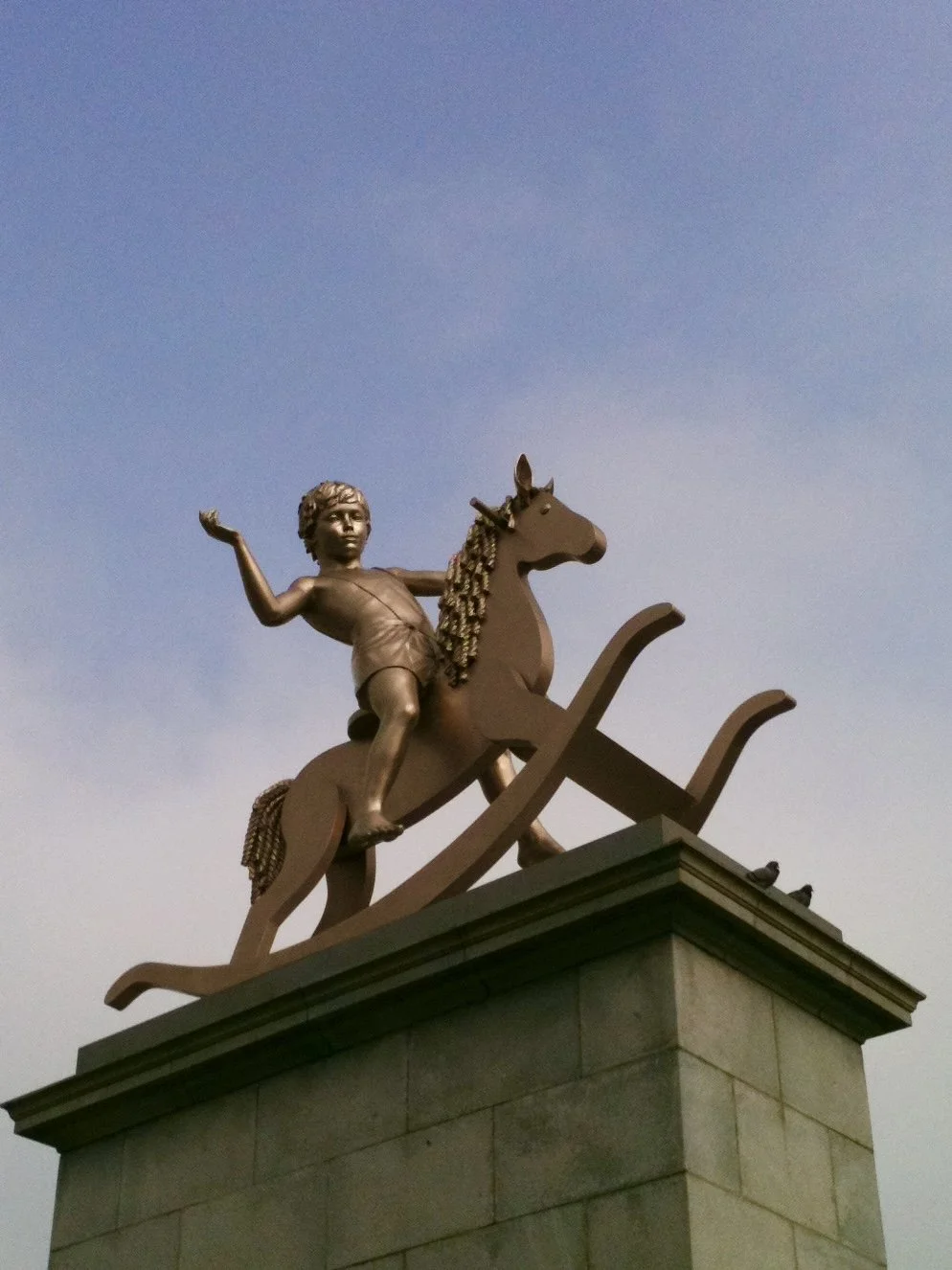
michael elmgreen and ingår dragset, powerless structures, fig.101, 2012
if you spend any time in london, chances are you've walked through trafalgar square. it's a place that is permanently busy, full of tourists, pigeons, demonstrations, celebrations and people taking photographs of nelson's column.
but look towards the north-west corner of the square and there's something else worth paying attention to: the fourth plinth.
it's a pretty simple idea really. an empty pedestal, originally intended to hold an equestrian statue of king william iv, was left without a sculpture because there wasn't enough money to complete the original plan. for more than 150 years, it remained empty.
then, in the late 1990s, someone decided that rather than filling it with another traditional monument, perhaps it could become a home for contemporary art. and so it was that the fourth plinth project was born in 1998, and since then the pedestal has hosted a succession of temporary commissions by artists from around the world.
it's a brilliant idea. trafalgar square is steeped in british history, with nelson's column and its surrounding statues celebrating military and political figures. the fourth plinth offers something different: a chance to put contemporary art right in the middle of it all, where millions of people can see it for free.
since it’s inception, 16 works have graced the platform with variety seemingly the brief.
a few favourites from the past
one of the earliest works i remember making a real impression was marc quinn's alison lapper pregnant, installed in 2005. it was a monumental marble sculpture of artist alison lapper, who was born without arms and with shortened legs, depicted eight months pregnant.
it was a striking choice for a public monument. rather than celebrating a military hero or historical figure, it presented a contemporary woman, disabled and pregnant, on a pedestal in one of the country's most prominent public spaces. it challenged conventional ideas about beauty, motherhood and who gets to be represented in public sculpture.
whatever your view of the work, it was difficult to ignore. and that's one of the things i like about the fourth plinth: it makes you think about what a monument is supposed to be, and who it is supposed to represent.
in 2009, antony gormley's one & other took the idea in a completely different direction. rather than installing a permanent-looking sculpture, gormley invited members of the public to occupy the plinth, one person at a time, for an hour. over 100 days, 2,400 people took their turn, standing, sitting, dancing, performing or simply being themselves.
it was a fascinating experiment in public art. the artwork wasn't a single object but a series of human experiences, played out in front of a crowd of passers-by. it was also a reminder that art doesn't necessarily have to be something made from marble, bronze or steel. sometimes the person standing on the pedestal is the artwork.
the following year brought one of my personal favourites: yinka shonibare's nelson's ship in a bottle. a detailed replica of hms victory, nelson's flagship at the battle of trafalgar, was enclosed in an enormous glass bottle. the ship's sails were made from brightly patterned african textiles, bringing a riot of colour to the square.
i loved the combination of the familiar and the unexpected. here was a miniature version of a ship associated with british naval history, dressed in fabrics that referenced african identity and the legacy of colonialism. it was playful, beautiful and thought-provoking without needing to shout about it.
the work eventually found a permanent home outside the national maritime museum in greenwich, where i've recently been to see it again. it's worth seeking out.
then came hahn/cock by katharina fritsch in 2013: an enormous, bright blue cockerel standing proudly on the plinth. it was a wonderfully absurd sight, especially against the surrounding architecture and the more traditional monuments of the square.
i loved the sheer confidence of it. a giant blue bird in the middle of trafalgar square. why not? it was funny, memorable and impossible to miss, and it proved that contemporary sculpture doesn't always have to be solemn to be taken seriously.
in 2016, david shrigley's really good offered another kind of humour. a giant bronze hand giving a thumbs-up, with an exaggeratedly long thumb, stood ten metres above the square. it was a simple gesture made ridiculous by its scale, and that was precisely the point.
shrigley has a particular talent for taking something ordinary and making it funny, slightly uncomfortable or unexpectedly meaningful. the thumbs-up could be read as a straightforward expression of optimism, or as a knowing joke about the pressure to insist that everything is fine. either way, it was a piece of public art that made me smile.
and then there was heather phillipson's the end, installed in 2020. this was altogether stranger: a giant swirl of whipped cream topped with a cherry, accompanied by a fly and a drone. it looked like something that had escaped from a surrealist dessert trolley and landed on top of a monument.
the drone filmed passers-by and its footage was broadcast on an internet livestream. as you do.
enter lady in blue
the latest commission is lady in blue by tschabalala self, unveiled in september 2026.
self is an american artist whose work explores representations of the human figure, particularly women. her fourth plinth sculpture depicts a woman in a blue dress, striding forward. made from bronze and finished in a vivid lapis-lazuli blue, she brings a contemporary figure into a square otherwise dominated by historical monuments.
i like the idea behind it. rather than commemorating a king, a general or a national hero, the sculpture celebrates an everyday woman — someone who could be one of the many people walking through the square on any given day.
and visually, the blue is fantastic. it's bold, unmistakable and completely at home in a square that has always been a stage for public spectacle. it also continues the fourth plinth tradition of using colour and unexpected imagery to challenge our expectations of what a monument should look like.
there's something appealing about the fact that the plinth keeps changing. one year it's a giant blue cockerel; another it's a thumbs-up, a ship in a bottle or casts of 850 trans people (teresa margolles, 850 improntas 2024). now it's a woman in blue.
each artist gets to respond to the same space, but the results could hardly be more different.
why the fourth plinth matters
i'm not going to pretend that i analyse every work in great depth, or that i always understand what an artist is trying to say. that's not really how i approach art. what i enjoy is the experience of seeing something unexpected in a familiar place, and having a reason to stop and look.
the fourth plinth does that brilliantly. you don't need to buy a ticket, read an essay or even plan a visit. you can simply walk across trafalgar square, look up and find yourself confronted by something completely unexpected.
and because the works change, there's always a reason to go back. you might love one commission and be less convinced by the next. you might find one funny, another moving and another completely baffling. that's all part of it.
public art is by nature, out in the world, where people can encounter it on their own terms. it should be allo to surprise you, annoy you, make you laugh or make you think. it doesn't have to appeal to everyone, and it certainly doesn't have to be understood by everyone.
for me, the fourth plinth is one of the best examples of how contemporary art can work in a public space. it brings art to people who might never choose to visit a gallery, and it gives even the most familiar corner of london the capacity to surprise.
so next time you're in trafalgar square, take a moment to look up.
and if you don't like what's there, don't worry. give it a couple of years. something new will be along soon.
explore more perspectives on contemporary art, collecting and the things that make us look twice.